 Rivenditori Mondiali della Gamma Pirelli Collezione
  Pay In 3
  Michelin Collections Distributori nel Regno Unito di pneumatici classici e d'epoca
Pneumatici Toyota Celica
Toyota Celica Tyres
-
Toyota Celica Pressure Guide

Toyota Celica Generation key:
- Generation 1: 1970-1977
- Generation 2: 1977-1981
- Generation 3: 1981-1985
- Generation 4: 1985-1989
- Generation 5: 1989-1993
- Generation 6: 1993-1999
Model Generation Front (Psi) Rear (Psi) 1600 GT 1 28 28 1600 ST 1 27 27 2000 ST Liftback 1 27 27 2000 XT Liftback 1 28 30 2.0 GT Liftback 2 28 30 2.0 ST Liftback 2 28 30 2.0 XT Liftback 2 28 28 2.0 GT 3 24 26 2.0 GT Fi 4 33 33 GT 2.0 & Cabriolet 4 33 33 GT - Four 4 33 33 GT (14" Wheel) 5 39 39 GT (15" Wheel) 5 42 41 GT - Four 5 43 43 GT 6 33 33 GT Convertible 6 33 33 GT Liftback 6 33 33 GT-S Turbo 6 30 28 Sport Coupe GT 6 33 32 Sport Coupe ST 6 29 28 ST 6 29 29 ST Coupe 6 29 29 ST Liftback 6 29 29
Is your model of Celica not listed in our guide? Give us a call on +44 0 1302 711 123 for information regarding tyre pressures for your Celica, or if you have any other queries for us.
History of the Toyota Celica
The Celica made its debut at the 1970 Tokyo Motor Show alongside the Toyota Carina, in the December of the same year, the Celica was put on the market. Starting life as a two-door hardtop notchback coupe, the Celica was more stylish than most of their counterparts in Japan at the time and was an attempt at competing against the 1964½ Ford Mustang and other "Pony Cars" that were popular from the mid-60s to early 70's State-side. There were a few minor trim changes to the Celica throughout the first generation but the most significant update to it came in 1976, increasing the wheelbase, flattening the front end, the removable bonnet vents were replaced by vents formed in the bonnet pressing, and the removal of the twin vents seen on earlier models with a single cowl vent. Interior changes such as new upholstery and dashboards were added too.
The second generation of Celica was released in the model year 1978 in both notchback and liftback forms. the hardtop essence of the Celica was removed as coupe and liftback variations has frameless door glass featured and the Griffith company in the US offered a Targa-style convertible conversion to the Coupe called the Sunchaser, this eventually led to these conversions being Toyota approved and sold through Toyota dealers due to their popularity. These conversions are now rare and sought after Celica models.
In 1981 the third generation of Celica was introduced, still available in notchback coupe and liftback variations upon launch, the convertible model came about in 1984 and was made in the US instead of the two Toyota plants in Aichi. Fuel injection became standard in all North American Celicas in August 1982. Another notable enthusiast's Celica is the GT-TS, with only 200 units built, the GT-TS was designed to meet the FISA regulations for a WRC Group B Rally Car These were the basic cars for the Celica Twincam Turbo which were rallied by Toyota Team Europe. This car was a great success, claiming victories in three consecutive Marlboro Safari Rallies
In 1985 the fourth generation of Celica was unveiled. This generation featured a stark change in the Celica's construction. Switching to front-wheel drive and 2.0 L four-cylinder engines, complete with a new sleek and smooth body. The next year the Toyota Celica GT-Four was introduced and immediately became the flagship Celica and the official Toyota Rally Car throughout its production, claiming its first WRC victory in Australia in 1989.
1989 brought around the fifth generation of Celica, with it came new rounded styling and upgrades in wheels and tyres in all models. The GT-Four became even more powerful, adopting a better cooling system and in Japan, four-wheel steering models were exclusively made. Anti-lock brakes were available on the GT-S models throughout the generation and were available on the GT for the '92 and '93 models. The homologation special Celica GT-Four RC was launched in 1991, made to fit FIA regulations for Group A in the WRC, export models were named the Carlos Sainz Limited Edition in honour of the Toyota team rally champion, Carlos Sainz. Only 5000 were produced of this model in total.
in 1993, Toyota launched the sixth generation of Celica, with many comparing the new styling to that of the Supra, coming full circle from the Celica Supra of the second generation. models of this generation came in Notchback coupe, Liftback, and Convertible forms. The most powerful form of the GT-4 was produced this year, however, this car and the Toyota rallying team were banned from competition after its victory in the 1995 WRC due to turbocharger fixing. In 1998, the ST models of Celica were discontinued in the States, leaving only the GT models.
Innertube Guides
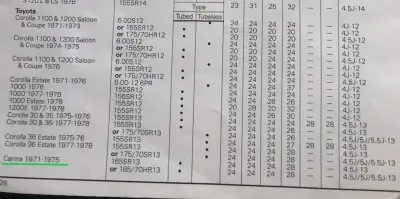
1978 Dunlop Toyota Fitment Guide Pg1
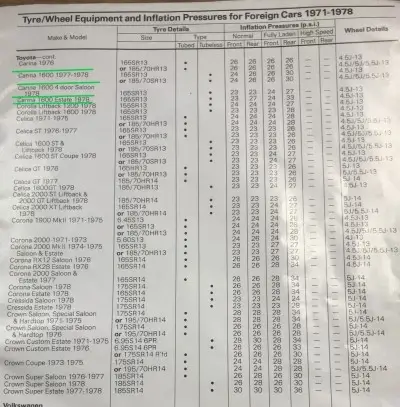
1978 Dunlop Toyota Fitment Guide Pg2
Recommend Tyres for Pneumatici Toyota Celica
Recommend Tyre Sets for Pneumatici Toyota Celica
Discount applied when bought as a set!